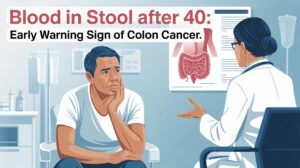
Why Does Your Stool Have Blood after 40?
It is amazing how even to the age of 40 is an accomplishment, but your body starts sending you smaller signals that something needs to be done. And one of them is seeing blood in wiping or in the loo. It may appear bright red, like raw meat, or more subdued, nearly black, like stale coffee grounds that have been allowed to settle. It occurs because the lining of your large intestine, or colon, becomes irritated or hurt. After decades of food processing past age 40, there is wear and tear, and little blood vessels there are more likely to rupture. But occasionally it’s not just irritation, it’s an alarm signal that colon cells are transforming in a way they shouldn’t.
What’s Actually Occurring Within Your Colon Cells?
Picture your colon as an extended pipe lined with millions of microscopic cells working together to expel waste. The cells are supposed to develop, do their job, and then die in a coordinated manner to be replaced by fresh ones. But after four decades, things start going wrong. At the cell level, the directions in your DNA. The instructions for each cell begin to get mixed up due to things you eat, smoke, or even just poor luck.
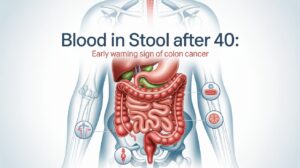
A cell can ignore the “stop growing” signal. It just grows too much, numbering into a small bump called a polyp. Most polyps are harmless, like a skin tag inside. But some continue to mutate. Their DNA has higher amounts of errors and they learn how to avoid the DNA clean-up crew immune system which would otherwise identify and destroy misfits. These damaged cells further invade deeper and deeper into the wall of the colon as time goes by, destroying small blood vessels in the process. That’s when blood seeps out with your bowel movement. It’s not a gush; usually just streaks or spots. But it’s the body flagging: “Something’s wrong down here.”
Is It Always Cancer, or Might It Be Something Else?
No, not always. Blood may be from simpler problems that resolve themselves or with a little assistance. Hemorrhoids/expandable veins in the tissue around your bottom come from straining too vigorously on the toilet. Small cuts in the skin there, known as fissures, bleed bright red too. Even beets or iron tablets eaten can make everything appear reddish with no trouble. But at 40 and above, chances are different. Bleeding polyps are more common, and about one out of ten of those would develop cancer if left for years on their own. The huge difference? Cancer blood will mix with stool, not just on the surface, and it comes back with no apparent cause like constipation.
Why Do These Cells Change?
The polyp is small and may be the size of a sesame seed. And, in some cases, it bleeds. But the more cells are dividing, the faster the growth occurs. It becomes a bulge that irritates passing waste, creating more bleeding. Further on, cancer cells begin infiltrating nearby tissue, as roots grow through soil. They make chemicals which break down walls of blood vessels, causing leaks more sustained. Your body attempts to resist, there is inflammation, and it brings increased blood to the site but that can potentially further the bleeding. After years or months, none the wiser, it eventually spreads to lymph nodes or further, but if you catch it early, that cold gets shut down.
What if you notice blood?
Document what you see: color, frequency, pain or change in bathroom routine. Discuss with a doctor so that he can possibly recommend a simple at-home poop test that measures occult blood. If necessary, an emergency scope (flexible tube with a camera) allows them to take a peek in and cut out any suspicious polyps there and then. Sealing the pothole before it develops into a sinkhole. Fiber as fruits and vegetables does makes it go smoothly, cools inflammation. No cigarettes and exercise mean that your cells will stay healthy longer.
Colon Health After 40: 10 Simple Ways to Track Your Health.
- Stay hydrated. so drink a lot of water.
- If you want to, then eat red meat no more than once or twice in a week.
- Stop smoking causes damage to colon cells directly.
- Ask your physician to get you an in-home stool test kit once in a year.
- Record any bowel history in the family.
- Learn to exercise at least 30 minutes a day.
- No need to hold it and when you poop.
- Create less beer and spirits in order to alleviate gut stress.
- Have a colon checkup at 45, or earlier if bleeding.
Punajan, one of the best cancer treatment hospitals, wants to suggest that one little bleed may be nothing, but subsequent sightings after age 40 warrant an investigation. Your colon works hard for you to provide it with the respect it deserves to continue functioning powerfully.
For additional helpful insights on cancer care, go to www.punarjanayurveda.com.
REFERENCE LINKS:
https://www.mdanderson.org/cancer-types/colorectal-cancer/colorectal-cancer-symptoms.html
https://www.moffitt.org/cancers/colon-cancer/faqs/nine-colon-cancer-symptoms-you-should-not-ignore/